
Distinct Worldview: Unique Perspective of Blind Individuals
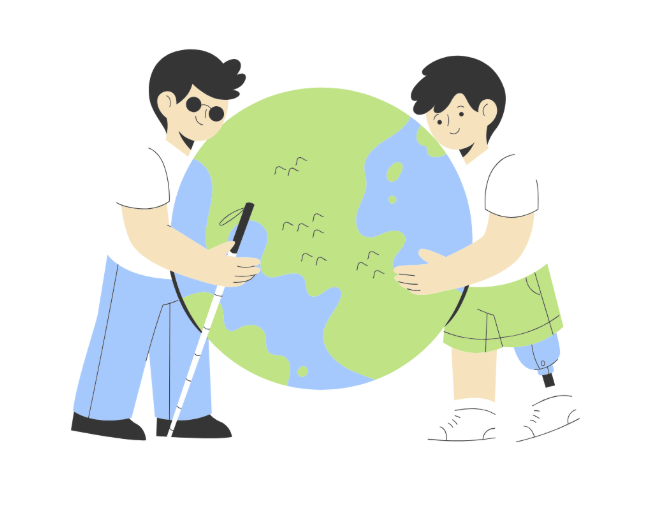
When sight is absent, perspective doesn’t vanish—it transforms. Blind individuals navigate the world not through visual cues, but through a rich tapestry of sound, touch, intuition, and emotional intelligence. Their experiences challenge conventional definitions of “seeing,” offering profound insights into human adaptability, creativity, and connection.
Seeing Without Sight
For many blind individuals, perception is multisensory. Instead of relying on visual input, they construct mental maps using auditory cues, tactile feedback, and spatial memory. Technologies like the “vOICe sensory substitution device” allow users to “see” through sound, translating visual scenes into auditory signals that the brain learns to interpret (University of Bath, n.d.).
This sensory adaptation is not merely functional—it’s transformative. It reveals the brain’s remarkable plasticity and the human capacity to reimagine reality through alternative channels.
Born Blind vs. Losing Sight
The experience of blindness varies widely. Those blind from birth often perceive the world through non-visual associations—texture, scent, rhythm, and emotion. A flower, for instance, is not a visual object but a sensory experience: the softness of petals, the fragrance, the sound of wind brushing through leaves (Turner, 2024).
In contrast, individuals who lose sight later in life may retain visual memories and even dream in images. Their perception blends memory with present sensory input, creating a layered understanding of the world that bridges past and present.
Insight as Strength
Blindness often fosters heightened emotional intelligence. Without visual cues, blind individuals rely on tone, language, and intuition to interpret social dynamics. This can lead to deeper empathy and nuanced understanding of others.
Moreover, blind individuals frequently challenge societal assumptions about ability and success. Their achievements—in music, technology, education, and advocacy—reveal that disability is not a deficit but a different way of engaging with the world. As Turner (2024) notes, “Sight is just one way of interpreting the world; when that’s gone, other senses pick up the slack”.
Reframing Disability
To reframe blindness is to recognize it not as a limitation, but as a source of insight. It invites designers, educators, and communities to rethink accessibility—not as accommodation, but as innovation. Inclusive design, sensory-rich environments, and empathetic communication benefit everyone, not just those without sight.
Conclusion
Blind individuals perceive the world differently—not less richly, but through different dimensions. Their lives illuminate the power of perception, the strength of adaptation, and the beauty of human diversity. In honoring their experiences, we expand our own understanding of what it means to truly see.
Blind individuals show us that perception is not confined to the eyes—it’s a symphony of sound, touch, memory, and emotion. Their experiences remind us that the world can be known in countless ways, and that insight often comes from looking inward rather than outward.
Thus, to see differently is not to see less—it is to see more deeply. Whether born blind or adapting to vision loss, these individuals navigate life with remarkable ingenuity and emotional clarity. Their stories challenge us to rethink what it means to understand, to connect, and to design a world that welcomes every way of perceiving.
Therefore, when we embrace blindness not as a deficit but as a dimension of human experience, we unlock new possibilities—for empathy, innovation, and inclusion. And in doing so, we begin to perceive the world not just with our eyes, but with our hearts.
References
University of Bath. (n.d.). How blind people see the world. https://www.bath.ac.uk/case-studies/how-blind-people-see-the-world/
Turner, A. (2024, December 23). What do blind people see? Insights into non-visual perception. NRIC-RI. https://www.nric-ri.org/what-do-blind-people-see/


Leave a Reply