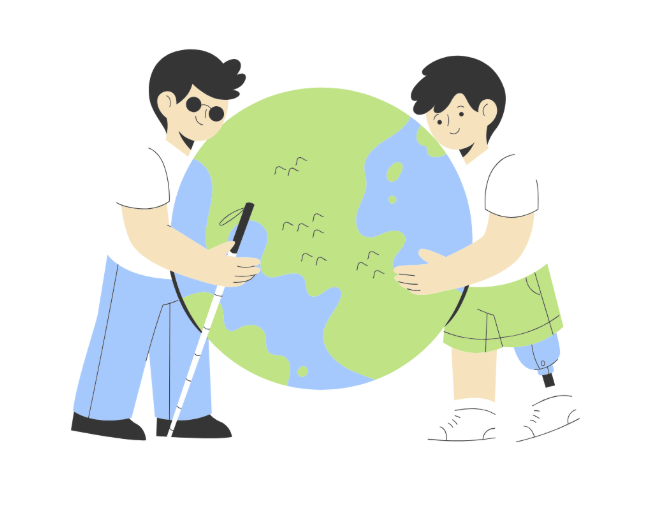
Achievements That Transcend Vision

Blindness is often misunderstood as a barrier to brilliance. Yet history and lived experience tell a different story—one of intellectual innovation, artistic mastery, and emotional insight that reverberates far beyond the limits of sight. These echoes of brilliance challenge assumptions and illuminate the extraordinary capacities of blind individuals.
Intellectual Innovation
Blind individuals have made profound contributions to science, law, education, and technology. Their insights often emerge from necessity—adapting to a world not built for them—and from a unique way of perceiving problems.
Consider Dr. Abraham Nemeth, a blind mathematician who developed the Nemeth Braille Code, enabling blind students to access complex mathematical notation (American Printing House for the Blind, n.d.). Or Haben Girma, a deafblind lawyer whose advocacy for inclusive technology has shaped global accessibility standards (Girma, 2020).
These achievements are not exceptions—they’re evidence of how blindness can foster alternative thinking, resilience, and innovation.
Artistic Mastery
Art is not confined to the visual. Blind musicians, poets, sculptors, and dancers create works that resonate across cultures and senses. Their artistry often draws from heightened sensitivity to rhythm, texture, and emotion.
Stevie Wonder, blind since infancy, revolutionized music with his fusion of soul, funk, and social commentary. His compositions are rich with emotional nuance and technical brilliance. Similarly, Esref Armagan, a blind painter from Turkey, creates detailed landscapes and portraits using tactile techniques—proving that visual art can be born from touch and memory (Armagan, n.d.).
These artists remind us that creativity is not limited by sight—it is expanded by perception.
Emotional Insight
Blind individuals often develop deep emotional intelligence. Without visual cues, they rely on tone, language, and intuition to navigate relationships and social dynamics. This can lead to profound empathy and insight.
Research suggests that blind individuals may outperform sighted peers in tasks involving verbal memory and auditory discrimination—skills that support emotional attunement and nuanced communication (Occelli et al., 2017). Their lived experience fosters resilience, adaptability, and a rich inner life.
Redefining Brilliance
To transcend vision is not to escape it—it is to expand the definition of brilliance. Blind individuals challenge the notion that intelligence, creativity, and success must be seen to be validated. Their achievements echo across disciplines and generations, inviting us to listen more deeply, design more inclusively, and celebrate more broadly.
Conclusion
The achievements of blind individuals remind us that brilliance is not bound by vision—it is born from insight, imagination, and perseverance. Whether crafting mathematical systems, composing timeless music, or advocating for global change, their contributions illuminate the vast spectrum of human potential.
To truly honor these achievements, we must move beyond admiration and into action—challenging stereotypes, expanding access, and embracing diverse ways of perceiving and creating. Blindness does not diminish the human spirit; it reveals new dimensions of it.
In celebrating brilliance that transcends sight, we open our eyes to a deeper truth: that greatness is not something we see—it’s something we feel, learn from, and carry forward together.
References
American Printing House for the Blind. (n.d.). Abraham Nemeth: A legacy of accessible mathematics. https://www.aph.org/abraham-nemeth-a-legacy-of-accessible-mathematics/
Armagan, E. (n.d.). Esref Armagan: Painting without sight. https://www.esrefarmagan.com/
Girma, H. (2020). Haben: The deafblind woman who conquered Harvard Law. Twelve.
Occelli, V., Spence, C., & Zampini, M. (2017). Audiotactile interactions in blind individuals: Evidence for enhanced spatial processing Multisensory Research, 30(1), 1–24. https://doi.org/10.1163/22134808-00002565